Guides / For Shops
Selling Bearings and Hardware to Bike Part Makers: What Shops Ask For
November 14, 2026
Machine shops that make bike components buy more than metal. Hubs, headsets, bottom bracket cups and suspension pivots all end up holding a bearing, and nearly every part is bolted to something. A shop that delivers an assembly, a kit or a part with its hardware needs a bearing and fastener source that answers precisely. This article is for suppliers of bearings and hardware who want to be that source.
Whether the shop or the brand buys the bearing differs by project, and we do not know how often either does. Many shops only machine the seat and the brand supplies the bearing. The advice here applies when you are asked to quote one. Nothing below promises orders.
What a machinist needs in the first reply
Machinists read quotes looking for the single piece of data that decides the fit. Put these items in the first message, not the third.
| Item | What to state | Why it matters |
|---|---|---|
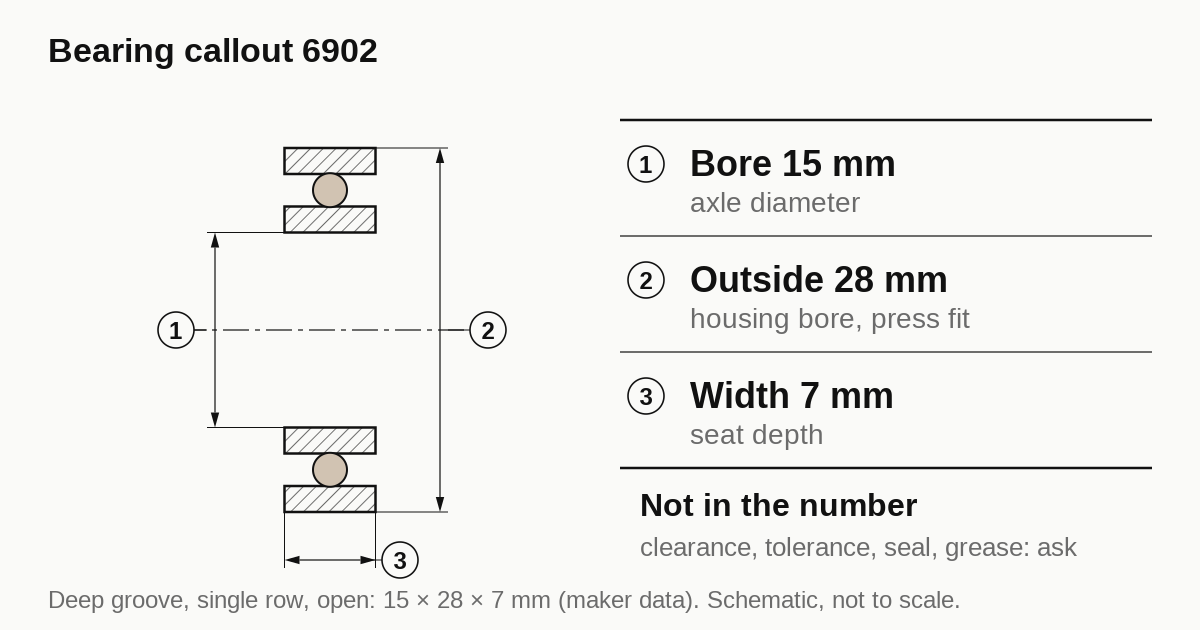
| Designation and size | For example 6902, with bore, outside diameter and width | A 6902 is 15 mm bore, 28 mm outside diameter and 7 mm wide in the NSK data, with a 0.3 mm minimum chamfer |
| Tolerance class | ABEC or ISO class, stated plainly | Sets how much of the seat and shaft tolerance the bearing uses |
| Radial clearance | CN, C3 and so on | Press fit shrinks it, so the choice affects drag and play |
| Seal or shield | Open, shielded or sealed | A seal adds friction and a shield does not seal; say which |
| Lubricant | The grease or oil, as named by the maker | Affects drag, temperature and washout |
| Maker and origin | Manufacturer, plant country where known | Traceability for the brand’s file |
| Lot marking | How you pack and label lots | A returned failure should trace to a batch |
The press fit guide shows why clearance and seat tolerance have to be chosen together, and the headset cup guide covers one common application.
Designations
Wikipedia notes that ISO 15 defines the alphanumeric designations for metric rolling-element bearings. A designation tells the machinist the series and the bore, but it does not tell the whole story. NSK lists the 6902 single row deep groove bearing with radial internal clearance options of C2, CN, C3, C4, C5 and CM, and it notes that CM is not interchangeable with the others. A quote that gives only “6902” leaves the clearance, the class and the seal open.
Tolerance class and the ABEC trap
Wikipedia describes the ABEC scale as an industry standard for the tolerances of a ball bearing, in five classes: 1, 3, 5, 7 and 9, with a higher number meaning tighter tolerance. Its table maps them to DIN 620 classes P0, P6, P5, P4 and P2. Three limits are worth stating to a customer who asks for “the highest ABEC”:
- The scale does not rate noise.
- A higher class does not necessarily let the bearing spin faster.
- Overall quality depends on factors outside the class: the article says a high-quality ABEC 3 bearing could perform better than a poor ABEC 7 one.
If you sell a bearing with a higher class, say which dimensional characteristics it controls and show the maker’s data sheet. If you sell a standard class, say that too. A shop that has been told “higher is better” by another vendor will appreciate a plain answer.
Seals, friction and life
Wikipedia states that seals increase friction and can let contamination reach the lubricant, which is abrasive. For a bike, where a bearing lives near water, grit and cleaning spray, the choice between a low-drag shield and a sealed bearing is a design decision for the brand. Ask what the part will see. Do not claim a bearing is waterproof unless you have test data.
Catalog life ratings use L10, the life that 90 percent of bearings can be expected to reach or exceed, calculated as (C/P) to the power of 3 for ball bearings, where C is the dynamic load rating and P the equivalent dynamic load. ISO 281 describes life prediction. A machinist cares less about the number than about whether the quote states the rating and its basis, so give C and the standard behind it.
Substitutions
A common reason for a rejected bearing order is a quiet substitution: a different clearance, a different seal, a different maker with the same size. The rule that keeps a supplier trusted:
- Never substitute without telling the customer, and send the new datasheet with the notice.
- Describe differences, not equivalence. “Same dimensions, CN instead of C3” is information. “Equivalent” is not.
- Keep the lot together. Mixed lots complicate the brand’s records and any failure investigation.
Need a quote for this part? Get a quote for your bike parts
Hardware: fasteners for bike parts
Most bike parts use socket head cap screws and similar metric hardware, so a supplier must be clear about the strength class.
Property classes
ISO 898-1 is the international standard for property classes of externally threaded metric fasteners made of carbon steel, according to Wikipedia. A fastener supplier’s table (TR Fastenings, a commercial source) lists these minimum values:
| Property class | Tensile strength Rm, min (MPa) | Proof stress Rp0.2, min (MPa) |
|---|---|---|
| 8.8 (diameter 16 mm and under) | 800 | 640 |
| 10.9 | 1,040 | 940 |
| 12.9 | 1,220 | 1,100 |
The first number of the class corresponds to the nominal tensile strength in hundreds of MPa. State the class on the quote and mark it on the screw. Say whether your certificate of conformity covers the lot, and do not offer a certificate you cannot document.
Plating, hydrogen and baking
Wikipedia reports that steels with tensile strength below 1,000 MPa or hardness below HRC 32 are not generally considered highly susceptible to hydrogen embrittlement, and that steel above HRC 32 may be susceptible to early hydrogen cracking after plating processes that introduce hydrogen. Failures can be delayed by weeks to decades. Baking after electroplating is commonly used, but it is not always fully effective, and the article names ASTM F1940 for process control of plated fasteners.
By our reading, class 12.9 screws, which have a minimum tensile strength of 1,220 MPa, sit above that 1,000 MPa line. If you sell them plated, state the coating, whether the plater bakes, and what quality check applies. A supplier that volunteers this information is easier for a safety-critical bike part to trust.
Stainless, titanium and aluminum
When a screw touches aluminum, galvanic corrosion can matter. Wikipedia’s anodic index table gives about -0.50 V for 18 percent chromium stainless steel and -0.90 V for wrought aluminum other than the 2000 series, and about -0.30 V for titanium. By subtraction, that is a 0.40 V difference for stainless against aluminum and 0.60 V for titanium against aluminum. The page’s recommended maximum difference is 0.15 V in harsh outdoor or salty conditions and 0.25 V in normal environments, and it lists electrical isolation and blocking the electrolyte with grease or coatings as mitigation.
That does not mean a stainless screw in anodized aluminum fails. It means the shop and brand should choose the combination, the coating and the grease on purpose. A supplier can help by stating the screw’s material and coating exactly. The 17-4 PH hardware guide covers one stainless option, and the pivot hardware guide shows how axles, bushings and bearings go together.
Small lots and paperwork
Bike component shops often buy small quantities, in our view. A supplier that handles small orders with clear terms stands out. State:
- Minimum order and pack size, with the price per piece at two or three quantities
- Stock status and lead time, kept honest: say “in stock” only when it is
- Sample policy, and whether samples are free or charged
- Certificate of conformity or datasheet per lot, if you provide them
- Packing with the part number, quantity and lot code on the label
- How returns and mismatches are handled
The billet supplier guide makes the same points for metal, and most apply here. Do not claim certifications you do not hold, and do not describe a standard you cannot name.
A first reply template
- Designation, dimensions, tolerance class, clearance, seal, lubricant, maker
- Price per piece at three quantities, minimum order, lead time from stock
- Lot marking and the document that comes with each lot
- Any known limit: temperature, speed, load rating with its basis
- For fasteners: material, property class, coating, bake if applicable
- A named person and a reply time: within 24 business hours is a good promise
If you supply bearings, fasteners or other hardware to bike part makers, register as a vendor. Free to list. Partner shops use the page to find sources, and nothing on it promises orders.
Sources
- Wikipedia, Rolling-element bearing
- Wikipedia, ABEC scale
- Wikipedia, Hydrogen embrittlement
- Wikipedia, Galvanic corrosion
- Wikipedia, Screw (standards)
- NSK, 6902 deep groove ball bearing data
- TR Fastenings, mechanical properties of steel screws and bolts (commercial, directional)
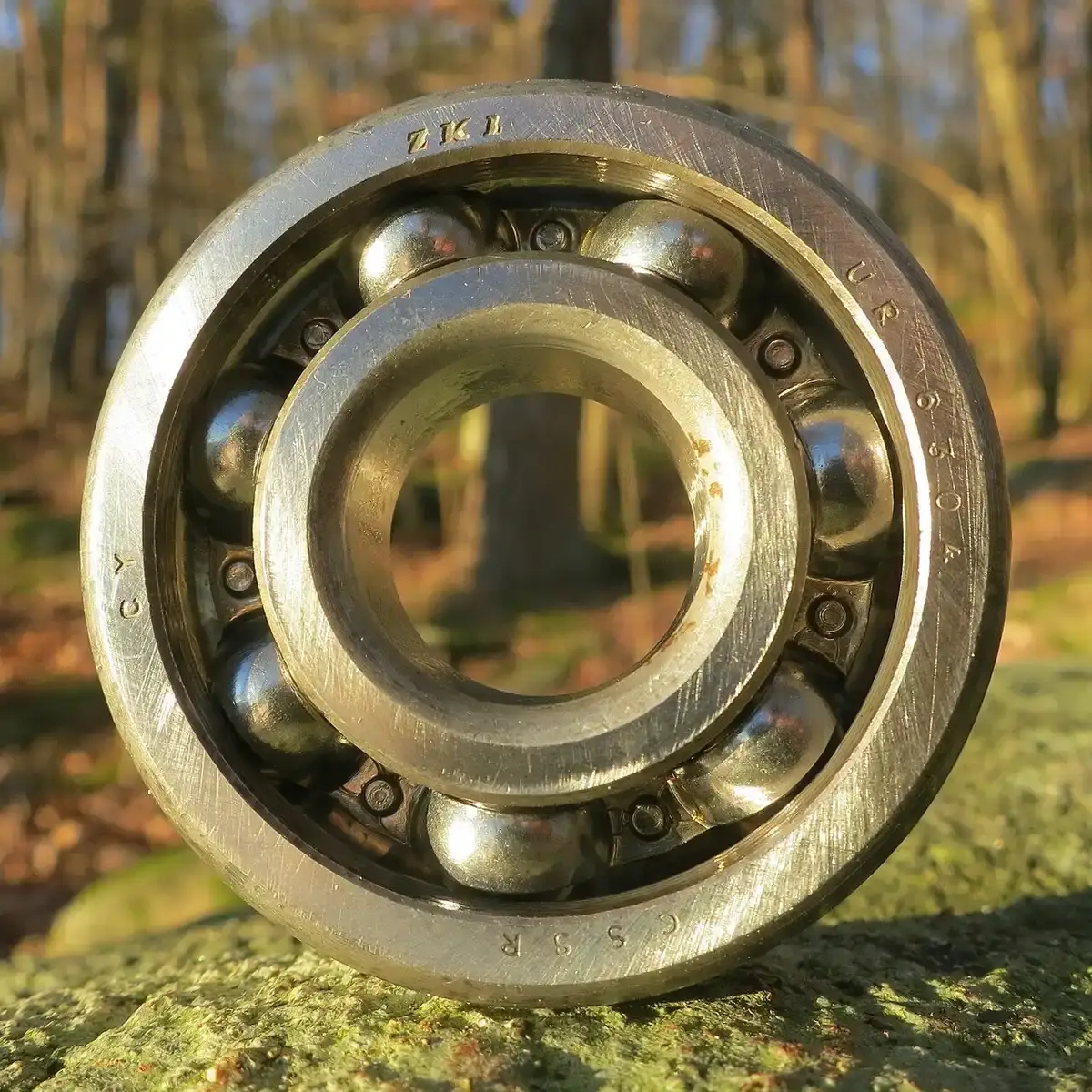
- Wikimedia Commons, 1984 deep groove ball bearing UR 6304 by ZKL

Frequently asked questions
What should a bearing supplier state in a first reply to a bike part machinist?
The full designation with dimensions, the tolerance class, the radial clearance, seal or shield type, the lubricant, the manufacturer and country of origin, and how lots are marked. Dimensions alone do not define a bearing: the same 6902 size comes in several clearance groups, and a different one changes the fit after a press fit.
Does a higher ABEC class mean a better bike bearing?
Not by itself. The ABEC scale rates dimensional tolerance in five classes, 1, 3, 5, 7 and 9. It does not rate noise, and a higher class does not necessarily allow a higher speed. A good ABEC 3 bearing can outperform a poor ABEC 7 one, so describe the quality controls, not just the class.
Why do plated high-strength screws need baking?
Electroplating can introduce hydrogen into steel. Steels above about 1,000 MPa tensile strength or HRC 32 can crack later from hydrogen embrittlement. Baking after plating is a common relief, but it is not always fully effective. A supplier should say what coating and what bake were applied to class 12.9 screws.
Can I swap a stainless screw for a steel one in an aluminum bike part?
Do not swap silently. Stainless steel and aluminum sit about 0.40 V apart on the anodic index table, and the guidance is 0.15 V in harsh outdoor conditions. Anodizing, grease or an isolating washer can break the path, but the change is a design decision for the brand and the shop.
Need a quote for this part?
Send the drawing. We quote the finished parts, place the work with a partner shop that machines bike parts and reply within 24 business hours.
Get a quote for your bike parts