Guides / Design
Full-Suspension Pivot Hardware: Axles, Bushings and Bearing Seats
October 29, 2026
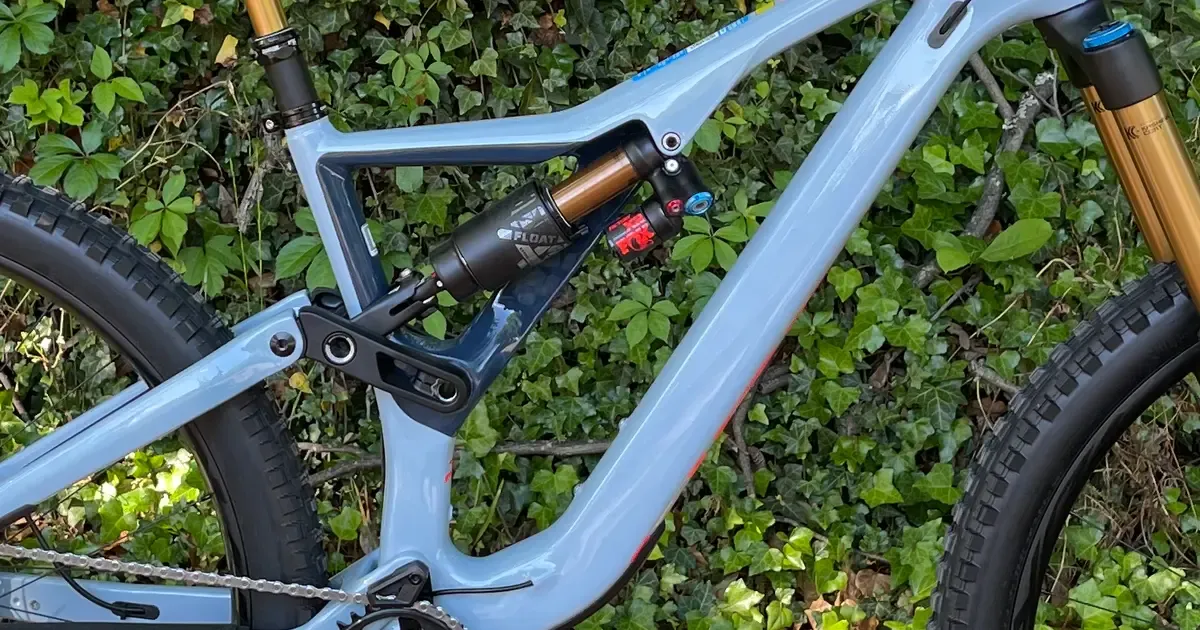
A full-suspension frame is only as good as its pivots. The links and seat stays get the attention, but the small hardware inside them decides whether the bike still feels tight after a season. For a brand that buys machined pivot hardware, the part list is short: axles, spacers, bearing seats and bushings. The mistakes are mostly in how those parts fit together. This checklist covers what to put on the drawing and what to ask a shop.
Pivots are a stack, not a part
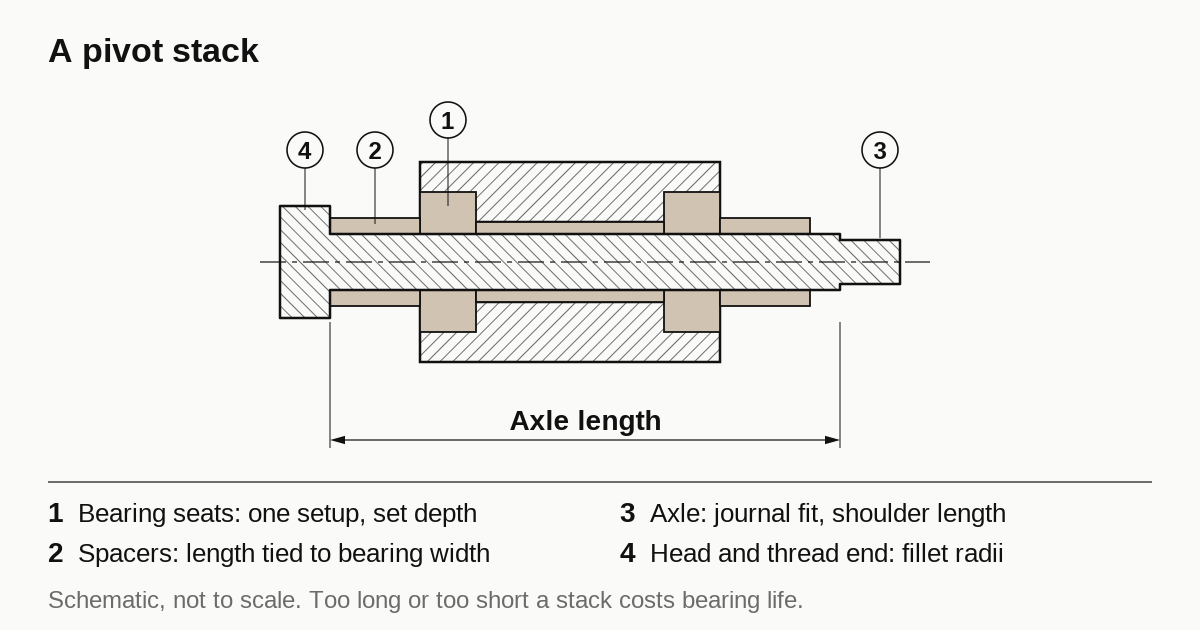
A pivot is a stack of parts that must agree in length and diameter: an axle, two bearings, spacers and the link or frame lug that holds them. The axle clamps the inner races, the housing holds the outer races and the spacers set the position. If the stack is too long the axle cannot clamp the bearing. If it is too short the bearings are squeezed sideways and wear early.
The bearing is the reference. A 6902 is one common size: NSK lists the open version at 15 mm bore, 28 mm outside diameter and 7 mm width, with a basic dynamic load rating of 4750 N and a static rating of 2260 N. Other frames use other sizes, and sealed versions list different ratings from different makers. The bearing maker’s catalogue is the source for load ratings and fits, and the frame drawing is the source for which bearing goes where. See the bearing press fit guide for the bore tolerance side.
Bearing or bushing
Pivot bearings do not rotate the way a wheel bearing does. They swing through a limited angle, loaded and unloaded as the suspension moves, and they sit exposed to water and grit. Bushings are another option: a plain bearing pairs a hardened, polished steel shaft with a softer sleeve, and bi-material designs pair a metal shell with a plastic surface that runs dry. Wikipedia’s plain bearing article describes bushings as sleeves inserted into a housing, with flanges that locate them and give a thrust face.
| Option | Strength | Watch for |
|---|---|---|
| Sealed ball bearing | Low friction, standard sizes, easy to source | Seat tolerance, seal drag, wear at small swing angles |
| Plain bushing | Compact, simple, tolerant of dirt | Bore finish, clearance, wear on the axle surface |
Rolling bearings that only oscillate through a small angle can suffer false brinelling, where vibration pushes lubricant out of the contact and the surface polishes into a mark that looks like a Brinell dent. A frame designer chooses the bearing, but the buyer should ask the shop about seat finish and fit so the part does not add problems. The choice is the frame maker’s, so state it on the drawing and do not let the shop substitute.
What the axle needs
A pivot axle is a turned part with two bearing journals, a head, a thread and a drive (a hex or Torx socket). On the drawing:
- Material and heat treatment. Aluminum 7075-T6 saves weight, 4130 chromoly is a steel option for higher loads, and 17-4 PH stainless resists corrosion. See the guides to 7075 tempers, 4130 chromoly and 17-4 PH hardware.
- Journal diameter and finish. The surface under the bearing inner race needs a stated fit. A bearing that spins on the axle wears the axle.
- Shoulder to shoulder length with a tolerance, tied to the bearing width.
- Thread class and length. In aluminum links, galling is a risk, since aluminum “will gall very easily” and hardened steel inserts are a standard fix.
- Fillet radii at every diameter change. Cracks start at sharp internal corners, and a pivot axle sees bending every time the suspension cycles.
- Surface treatment. Anodize changes diameters by half the oxide thickness per surface, so mask the journals or machine them to land in tolerance after coating. The anodize growth calculator does the arithmetic.
Torque is part of the drawing
Pivot torque is not standard across the industry. Two published torque tables show the spread. One frame with a rear linkage lists 14 Nm at the main pivot, 7 Nm at the dropout, 10 Nm and 14 Nm at the two link points and 10 Nm and 14 Nm at the shock mounts. A mountain frame range from another maker lists 15 Nm at the main pivot, with 8 to 12 Nm elsewhere depending on the model. Both say to follow the torque on the component or in the maker’s manual, and both warn that some pivot screws need thread locking compound to stay put.
The takeaway for a buyer is practical. Print the torque and the thread locker call-out on the drawing and the service sheet. A shop can only prove that a thread holds the torque if the drawing states it, and a service tech needs the same number.
Need a quote for this part? Get a quote for your bike parts
The seats and the link
Most of the work is in the link or lug that holds the bearings, not the axle. Ask for:
- Coaxial seats. Bearing seats on the same link must be bored in one setup, or the bearings will bind.
- Seat depth and shoulder. The shoulder stops the outer race, and the depth sets the stack.
- A drawing that names the bearing. Bore tolerance depends on the bearing and housing material, so work from the bearing maker’s fit.
- A gauge plan. Plug gauges or a bore gauge for the seats and a length check on the stack. The interface gauging guide covers it.
- Deburred bore edges. A burr at the seat edge stops the bearing seating square.
Frame designs differ in how many pivots they have. A single pivot has one main location, a four-bar design such as a Horst link or a virtual pivot point design has several, and each location is another set of hardware to machine and inspect. Count the locations before you ask for quotes and ask for the quote per set.
Common mistakes
- Axle too long or too short for the stack. Either one costs bearing life.
- Anodize on seats and journals with no growth allowance.
- No torque or thread locker on the drawing.
- Letting the shop swap the bearing for a cheaper one with a different seal or width.
- Testing the frame without the final hardware. A test frame with prototype axles proves little about production.
A frame with good pivots feels the same in year two as in week one. That comes from fit and stack control, not from fancy hardware. Send the pivot drawings through the RFQ page. We quote the finished parts within 24 business hours and place the work with a partner shop that cuts axles and linkages.
Sources
- NSK, 6902 deep groove ball bearing data
- Wikipedia, Plain bearing
- Wikipedia, Brinelling
- Wikipedia, Bicycle suspension
- Wikipedia, Galling
- Wikipedia, Anodizing
- GasGas, torque specifications (trekking)
- Husqvarna Bicycles, torque specifications (Mountain Cross)
Frequently asked questions
What bearings do full-suspension pivots use?
Most frames use sealed deep groove ball bearings pressed into the linkage, and some use bushings. The size is set by the frame maker. A 6902 is one common size, 15 mm bore by 28 mm outside diameter by 7 mm wide. Check the bearing part number on the frame drawing, never assume it.
What torque do pivot axles need?
It depends on the frame. One published full-suspension torque table lists 14 Nm for the main pivot and 10 Nm for a link, and another lists 15 Nm for the main pivot. Always use the value on the drawing or the frame maker's manual, and note any thread locker call-out.
Why do pivot bearings wear out early?
Pivot bearings swing through small angles under high loads instead of rolling steadily, and water and grit get past the seals. Wear shows as play at the wheel. Good seat tolerances, correct axle clamping of the inner race and sealed bearings reduce it but do not remove it.
Should a pivot axle be one fixed length?
No. Axle length must match the bearing stack, spacers and link width. State the shoulder-to-shoulder length with a tolerance and tie it to the bearing width, because an axle that clamps the bearings too hard or too loosely causes the same wear.
Need a quote for this part?
Send the drawing. We quote the finished parts, place the work with a partner shop that machines bike parts and reply within 24 business hours.
Get a quote for your bike parts