Guides / Design
Machining Eccentric Bottom Bracket Parts: Offset, Clamp and Shell Fit
November 5, 2026
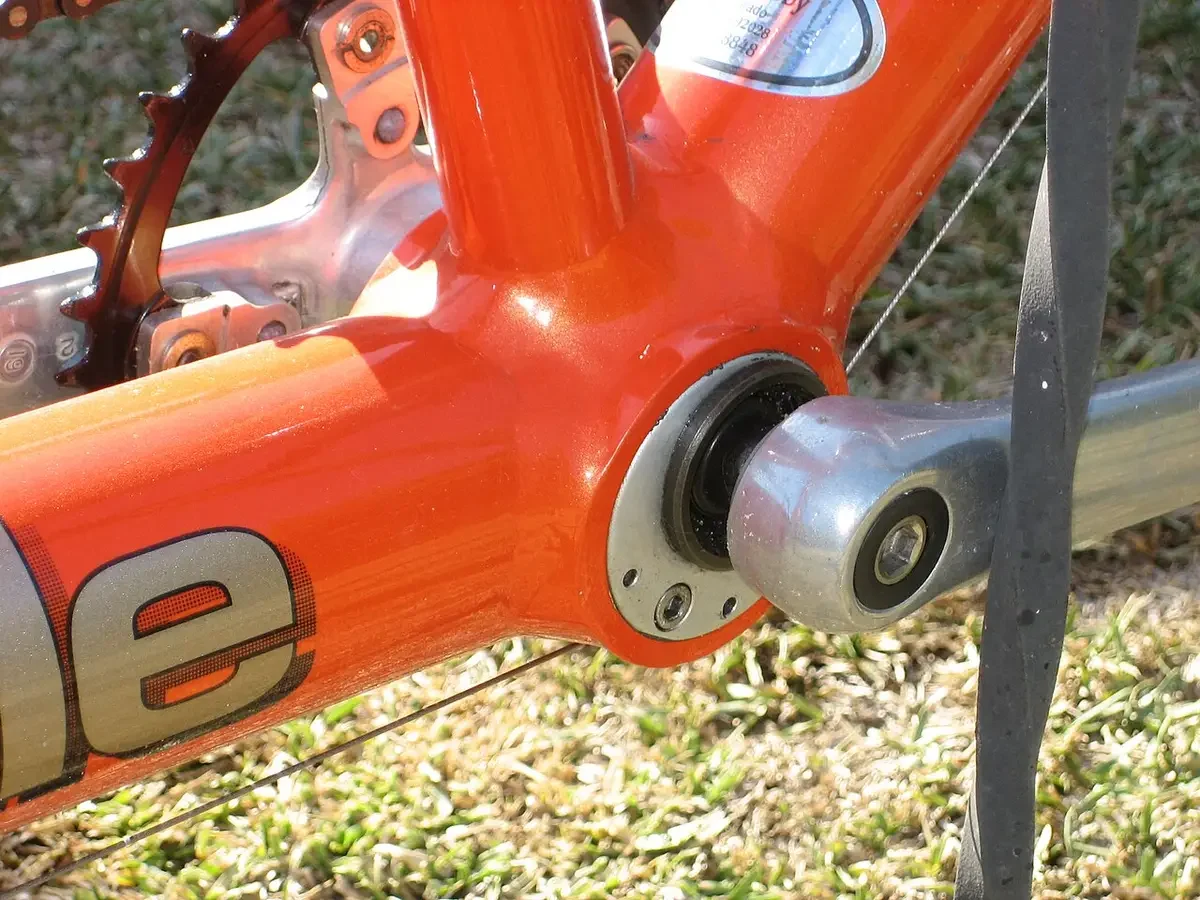
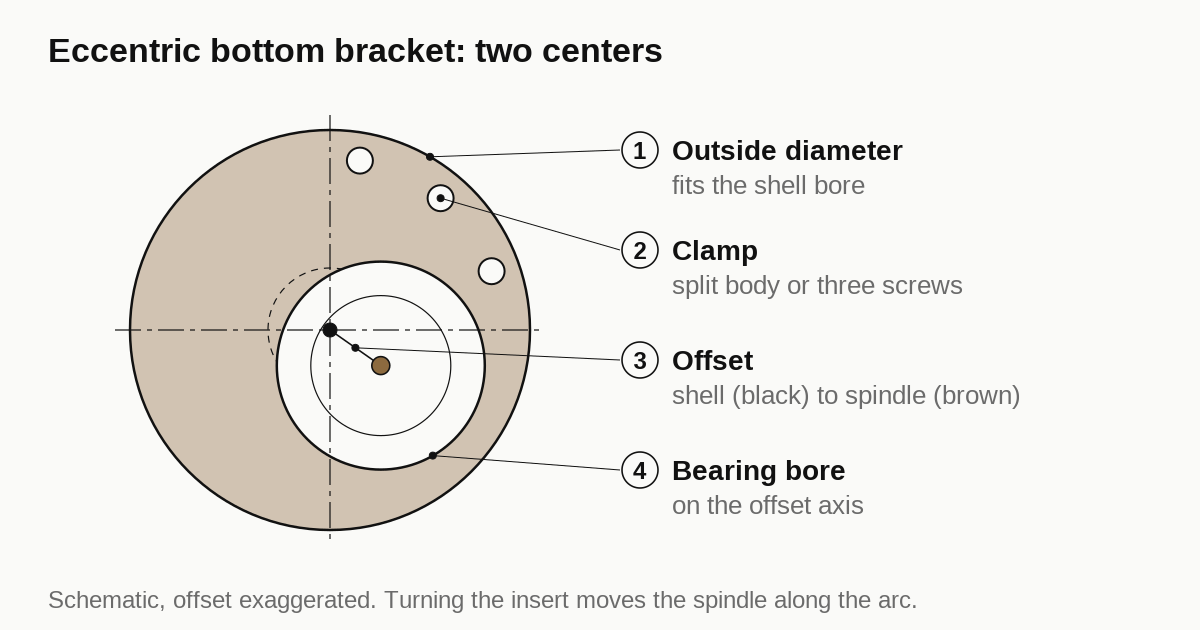
An eccentric bottom bracket (EBB) is a round insert that sits in an enlarged bottom bracket shell, with the bearings or cups off center. Turn the insert and the spindle moves along an arc: forward and back to set chain tension on a single-speed or internally geared bike, or up and down to change bottom bracket height. For a machine shop the part is simple to describe and hard to get right, because four features have to agree: the outside diameter, the offset, the bearing or cup bore and the clamp.
What an EBB is, from public sources
Wikipedia’s bottom bracket article describes an eccentric as an offset cylindrical plug that fits an enlarged shell. Rotating it moves the bottom bracket to adjust chain tension or height. The plug is fixed by set screws, a clamping shell, an expanding wedge or split halves held by screws. Typical uses are tandem timing chains, single-speeds, bikes with internal-geared hubs and bikes with vertical dropouts or rear disc brakes. The same article gives shell inner diameters of 42 to 55 mm, nominally.
Sheldon Brown makes the single-speed case: vertical dropouts are a problem when you want to dispense with a derailer, since you need some way to regulate chain tension, and a chain-tensioning pulley is the usual workaround. An EBB is another way to regulate it.
There are two construction types, per FIRST Components. A threaded eccentric has no bearings and works as an adapter that a standard threaded bottom bracket screws into. An integrated-spindle eccentric carries bearings and takes a 24 mm spindle crank directly. Which one you are quoting changes the drawing.
The four features that must agree
1. Outside diameter against the frame shell
The shell bore is whatever the frame maker made it, so there is no single standard size. Public examples show the spread. Wikipedia lists PF30 and BB386EVO shells at 46 mm, BB30 at 42 mm and T47 at 46 mm inside diameter. A Problem Solvers press-fit unit requires a 46 mm shell inner diameter and lists 68 and 73 mm shell widths. We found no public tolerance for the insert-to-shell fit. The right method is design-led: measure real shells from the target frames, set the fit from that spread and let the clamp take up the remaining clearance. The gauging guide covers how to check the bore and the tolerance guide covers the notation.
2. Offset
The offset is the distance between the shell axis and the spindle axis. Public figures differ, and they may not describe the same thing. MBR says one EBB has its sealed bearings offset 7 mm from the bottom bracket center, so you can drop bottom bracket height by as much as 7 mm or shorten the effective chainstay length by the same amount, or clock it between the two. Problem Solvers lists 16 mm of fore-to-aft adjustment for its E46. Those numbers describe different things: an offset in one case, a travel in the other. A drawing has to say which it means, give the offset with a tolerance and state the direction of the position marks. The offset also sets the thickness of the wall on the thin side, which matters for strength.
3. Bearing or cup bore
The bore holds either the bearing cups or the bearing seats, and it has to be concentric with the offset axis, not the outside diameter axis. For a threaded eccentric the bore carries a BSA thread. Wikipedia gives BSA as M34.798 x 1.058 mm (1.37 in x 24 TPI), left-hand thread on the drive side, and T47 as M47 x 1 mm, also left-hand on the drive side. A thread machined off axis creates misalignment that shows up as noise. Our T47 and BSA cup guide covers thread and face details, and the bearing press fit guide covers seats for press-fit units. Spindle compatibility belongs on the drawing as well. MBR notes that one EBB is not compatible with 30 mm spindles, so the crank interface has to be named, for example a 24 mm spindle crank (see the crank arm guide).
4. The clamp
FIRST Components describes a casing held by three short bolts spaced evenly around the outside, tightening onto the bearing unit. Finger tight is enough for single-speed use, and the maximum casing bolt torque is 2.5 Nm with 1 to 2 Nm suggested to avoid indenting the bearing cup. Rotate both sides together at the same pace, it says, so the unit does not jam. Other designs use a split body or an expanding wedge. The clamp decides how much the insert can slip under load, and the part that slips is the part that creaks. Specify:
- Number, thread and position of clamp screws
- Seat geometry for the screw tips, such as a flat or a cone point
- A torque from the design, not from another product
- Hardware material and thread locker
If screw tips seat on a bearing cup, the contact face needs a stated hardness or finish so it does not dent. FIRST’s note about indenting the cup is the failure to design against.
Material and finish
Most inserts are aluminum, and an aluminum thread in an aluminum shell is a galling risk. Wikipedia’s galling article says aluminum will gall very easily and that threaded inserts of hardened steel are often used in metals that gall. Where the insert threads into a frame, test the real pair with the grease or compound the user will apply. Anodize adds thickness: each surface grows by half the coating, so an outside diameter that must fit a shell bore needs either a post-anodize size or a mask. The Type II versus Type III guide and the anodize growth calculator give the numbers, and deburring before anodize covers the bore edges.
Need a quote for this part? Get a quote for your bike parts
Frame effects the brand should write down
MBR notes that an eccentric bottom bracket has no effect on head angle and avoids the clearance problems that offset shock hardware can cause when the suspension bottoms out. It also notes that the insert changes bottom bracket height and chainstay length in one move, so the brand needs to state the range it is willing to support. Chain tension is a second use. FIRST Components says a half to three-quarters turn sets single-speed chain tension, which is a useful target when you test a prototype.
What to put on the drawing
- Frame shell inside diameter and width, with the range of real frames
- Insert outside diameter and fit
- Offset with tolerance, and which direction the marks show
- Bearing seat or thread, and concentricity to the offset axis
- Spindle or crank interface the unit supports
- Clamp screws, torque and seating face
- Material, hardness and anodize type, masked areas and post-anodize sizes
- A named frame for the first article fit check
Common mistakes
- Quoting from a shell diameter in a catalog. Measure the frames.
- Mixing up offset and travel. The numbers are not interchangeable.
- Boring the seat off the outside diameter axis. It must follow the offset axis.
- Copying another maker’s clamp torque.
- Anodizing the fit diameter with no allowance.
Send the drawing and the target frames through the RFQ page. We quote the finished parts within 24 business hours and place the work with a partner shop with bottom bracket experience.
Sources
- Wikipedia, Bottom bracket
- Sheldon Brown, Singlespeed
- FIRST Components, What is an eccentric bottom bracket and how does it work
- MBR, Adjust your geometry with an eccentric bottom bracket
- Tree Fort Bikes, Problem Solvers E46 eccentric bottom bracket listing
- Wikipedia, Galling
- Wikipedia, Anodizing
Frequently asked questions
What does an eccentric bottom bracket do?
It holds the bearings off center in an enlarged shell. Rotating the insert moves the spindle, which sets chain tension on single-speed and internally geared bikes or changes bottom bracket height. Wikipedia describes it as an offset cylindrical plug that fits an enlarged shell and is fixed with set screws, a clamping shell, an expanding wedge or split halves.
What shell size does an eccentric bottom bracket fit?
It depends on the product. Wikipedia gives shell inner diameters of 42 to 55 mm, nominally. One PF30 unit requires a 46 mm shell inner diameter in 68 or 73 mm widths. There is no single size, so the drawing has to name the frame shell diameter and its tolerance.
How much adjustment does an eccentric bottom bracket give?
Listings differ because they measure different things. One press-fit unit is offset 7 mm from the shell center, so it can drop bottom bracket height by up to 7 mm. Another is listed with 16 mm of fore-to-aft adjustment. Ask whether a figure is offset or total travel.
How tight should the clamp screws be?
FIRST Components says a half to three-quarters turn of the casing sets single-speed chain tension, and gives a maximum casing bolt torque of 2.5 Nm, suggesting 1 to 2 Nm to avoid indenting the bearing cup. That is one design, so take the torque from your own design.
Need a quote for this part?
Send the drawing. We quote the finished parts, place the work with a partner shop that machines bike parts and reply within 24 business hours.
Get a quote for your bike parts