Guides / For Shops
Getting Your First Export Order for CNC Bike Parts
November 21, 2026
The first export order for CNC bike parts rarely comes from a big brand. It usually comes from a small brand or a start-up that sends a drawing, asks for a quote on 25 to 200 finished pieces and expects an answer fast. A shop that has never exported can win that order, but only if the quote already answers the questions an overseas buyer asks next: which Incoterm, which documents, how samples travel and how you get paid. This guide covers that preparation for a shop that mills aluminum bike components and wants its first export order to go smoothly. It starts after the part is within your capability. For how brands judge shops on the work itself, read how machine shops win bicycle component orders and the quoting mistakes that lose orders.
Get quote-ready before you look for a buyer
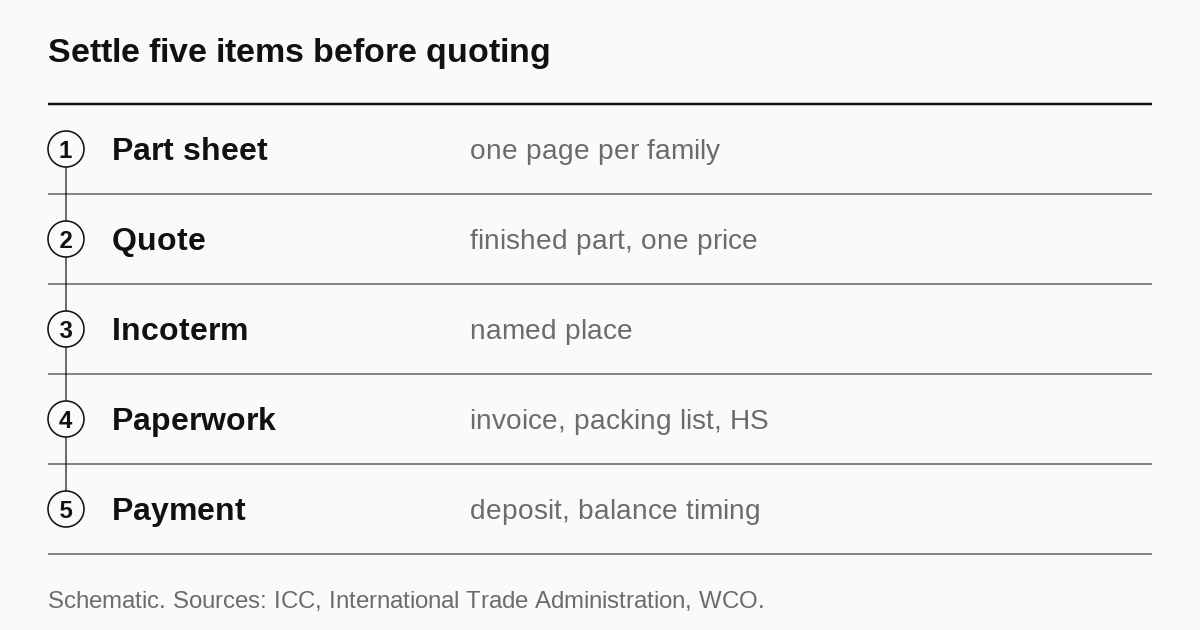
An overseas buyer reads your reply the way you would read an unfamiliar supplier’s: for what is missing. Prepare these once and reuse them on every inquiry.
| Item | What to have | Why it matters |
|---|---|---|
| Part family sheet | One page per family you want: stems, chainrings, hub shells, brackets. Envelope, axis count, alloys, the bore tolerance you hold, finishing route | A brand searching for a specific part type finds a specific answer |
| Quote template | One price for the finished part, with machining, finishing, packing and finishing lead time shown | Brands buy a part on the shelf, not machine hours |
| Incoterm | Your default and a fallback, each with a named place | Settles who pays and who carries risk at each step |
| Paperwork pack | Commercial invoice and packing list templates, HS description, packing spec | Avoids rewriting documents the day the parts are ready |
| Sample policy | What you send, in what quantity, with what record | Most first orders start with a sample |
| Payment method | What you need before you start and before you ship | Decides how much risk you carry on a stranger |
None of this needs a certificate or a large team. It needs decisions made before the inquiry arrives. Reply to every inquiry within 24 business hours, even if the answer is that you cannot take the part.
Where first export inquiries come from
No public statistic tells us how shops find their first overseas bike brand, so this section is our view, not a survey. Three routes come up most often in how this market works.
- Search by part type. Brands and sourcing agents search narrow terms such as a stem, a chainring or a derailleur hanger. A page or a one-page sheet that names the part, the envelope and the finishing route is easier to find than a generic capability list.
- Trade fairs. Eurobike, the bicycle trade fair, covers components as well as complete bikes. Its trade visitor days are Wednesday to Friday, according to Wikipedia. Exhibiting is a large cost for a first order, so many shops start by visiting, reading the exhibitor list and sending a sheet to brands that make the parts they are good at.
- People already in the chain. Anodizers, billet suppliers and test labs see which brands need a shop. A finisher that trusts your work will mention you. The anodizer’s view of a supplier swap shows how much a finisher notices.
Trading and sourcing platforms are a fourth route. Whichever route you use, do not promise capacity you do not have: a brand that gets burned by a first order does not come back.
Settle the Incoterm before the quote
An Incoterm is a three-letter term in the sales contract that says who does what, who pays for what and who carries the risk as the goods move. The International Chamber of Commerce describes Incoterms as a set of eleven trade terms, with Incoterms 2020 as the current edition. Wikipedia sorts them into seven rules for any mode of transport (EXW, FCA, CPT, CIP, DAP, DPU and DDP) and four for sea and inland waterway only (FAS, FOB, CFR and CIF).
They do not set the price, the currency or the credit terms, and they do not decide where title passes. Write those in the quote.
| Incoterm | What you take on | Fit for a first order |
|---|---|---|
| EXW | The buyer collects and handles export formalities | Risky: where the buyer cannot act as export declarant, you are stuck |
| FCA, named place | You clear the goods for export and hand over to the buyer’s carrier at the named place | Usually the cleanest: you control export paperwork, the buyer controls freight |
| DAP | You deliver to the buyer’s named address; the buyer clears import | Fits samples and small air shipments when you have a forwarder |
| DDP | You also pay import duty and taxes | Avoid on a first order: you carry duty you cannot control |
The EXW warning comes from Wikipedia’s Incoterms page: the buyer is responsible for the export documentation, and in some jurisdictions, such as the EU, a non-resident buyer may be unable to act as export declarant. The seller can also face tax exposure without proof of export. Our advice is to quote FCA at your own door or your forwarder’s warehouse, and to say so on the first line of the quote.
Duties are the buyer’s business. They change from year to year, so a shop should not guess them. Point the buyer to its own broker, and read the current picture in our guide to bicycle parts tariffs and the EU anti-dumping rules for bicycle parts so you understand why a buyer asks about country of origin.
Need a quote for this part? Get a quote for your bike parts
The paperwork on the first shipment
The US International Trade Administration lists the common export documents. For a small bike parts shipment, these are the ones that matter:
- Commercial invoice. A bill from seller to buyer that customs officials use to help determine duties. It states the goods and the amount the customer pays. Governments can set its form, content and language.
- Packing list. Describes the cargo so customs can check it. It is not a substitute for the invoice. It carries seller, buyer, shipper, invoice number, shipment date, quantity, description, package type, number of packages, net and gross weight in kilograms and package dimensions where relevant. The invoice should reflect the packing list.
- Air waybill or bill of lading. The carrier’s document. An air waybill is non-negotiable and allows tracking. A bill of lading is the contract between the goods’ owner and the carrier on ocean shipments.
- Certificate of origin. A signed statement of where the item was made. Some countries require it, and free trade agreement shipments may need extra certification.
Your own country adds its export declaration rules, and the destination adds import rules, so ask your forwarder what applies to both ends before the first booking.
The description on these documents should use the customs classification. Bicycle parts sit under heading 8714 of the Harmonized System. The WCO lists subheadings for frames and forks, wheel rims and spokes, hubs, brakes, saddles, pedals and crank-gear and a residual line for other parts. Which line a stem or an e-bike bracket takes is a decision for your customs broker. Ask for it in writing, use the same wording on every document and keep it with the part record.
Ship the sample like a real shipment
A sample is a shipment. Prepare an invoice and a packing list, state a value, describe the part in the same words every time and tell the buyer how it was packed. Whether a sample attracts duty depends on the destination, so let the buyer’s broker decide. Send a protected, labeled piece, and keep a twin with the same lot code and finish on your own shelf, so that you and the brand talk about the same part on a video call. The next article, samples, first article and fatigue evidence, covers what the brand then wants to see with it.
Agree how you get paid before you cut metal
The US International Trade Administration ranks the methods by risk to the exporter. Cash in advance means payment arrives before title passes, so credit risk disappears. Letters of credit put a bank between you and the buyer and are described as one of the most secure instruments available. Documentary collections offer no verification process and limited recourse in case of non-payment. Open account, where the buyer pays 30, 60 or 90 days after receiving the goods, is one of the highest risk options. Consignment is very risky.
For a brand you have never shipped to, our view is to ask for a deposit before cutting metal and the balance before the parts leave, and to put that in the quote. Small brands know this from their own suppliers. Our piece on working with bike start-ups covers milestone payments and IP. If a brand refuses any form of security on a first order, treat that as information about the brand.
A short first-order checklist
- Part family sheet and quote template ready.
- Incoterm and named place written in the quote.
- Finished-part price with finishing lead time shown.
- Invoice, packing list and HS description templates ready.
- Sample plan: what you ship, what you keep.
- Payment method and timing written in the quote.
- Forwarder contacted before the first booking, not the day of.
Talk to us
If your shop mills aluminum bike parts and wants to be considered for work for brands abroad, read the for suppliers page and talk to us. We will tell you plainly whether your parts and finishing route fit the requests we see.
Sources
- International Chamber of Commerce, Incoterms rules
- Wikipedia, Incoterms
- International Trade Administration, Common export documents
- International Trade Administration, Methods of payment
- WCO Trade Tools, Harmonized System 2017, heading 8714
- Wikipedia, Eurobike
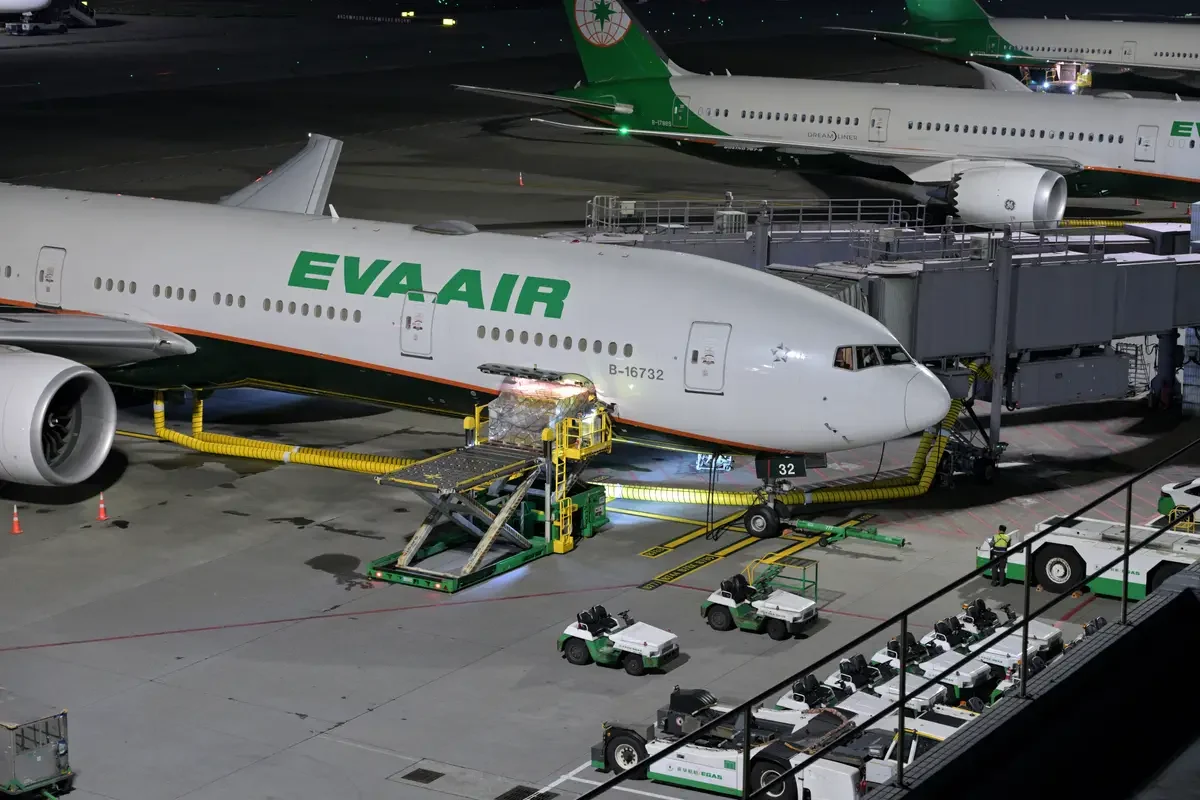
- Wikimedia Commons, Palletized cargo being loaded onto EVA Air Boeing 777-300ER B-16732 at Taoyuan May 2026

Frequently asked questions
Which Incoterm should a shop use for a first export order of bike parts?
Pick one before you quote and name the place. Under EXW the buyer handles export formalities, which can fail where a foreign buyer cannot act as export declarant. FCA at a named place, with you clearing the goods for export, avoids that. DDP puts import duty on you, so it is a poor choice for a first order.
What documents go with a first export shipment of machined bike parts?
At minimum a commercial invoice and a packing list that match each other, plus the air waybill or bill of lading from the carrier. Some destinations also ask for a certificate of origin. Your forwarder or the buyer's broker confirms what the destination country requires. Your own country's export declaration rules apply on top.
How should a shop get paid on a first export order?
The US International Trade Administration ranks cash in advance as the safest method for an exporter and letters of credit next, with open account among the riskiest. With a brand you have never shipped to, ask for an advance or a deposit with the balance due before the parts leave. Say so in the quote, not after the order.
Which HS code do CNC bike parts use?
Bicycle parts fall under heading 8714, with subheadings for frames and forks, wheel rims and spokes, hubs, brakes, saddles, pedals and crank-gear, and a residual line for other parts. Which line a stem, a bracket or an e-bike part takes is a classification decision for your customs broker. Put the same description on the invoice and the packing list.
Need a quote for this part?
Send the drawing. We quote the finished parts, place the work with a partner shop that machines bike parts and reply within 24 business hours.
Get a quote for your bike parts