Guides / For Shops
How a Machine Shop Plans Capacity for Bike Model-Year Launches
November 21, 2026
A bike brand does not order evenly through the year. It orders around a model year, a trade show or a dealer pre-season window, and the parts for each have to be in the warehouse before it. For a machine shop, that shows up as a quiet few months followed by several customers asking for first articles and releases in the same weeks. This guide shows how a shop reads the brand’s calendar, finds the step that limits output, protects it and works a wave of releases back from the ship dates. It is written for the owner or planner of a shop that mills aluminum bike parts. The brand-side view of the same dates is in five gate reviews for a bike component launch.
Why bike orders arrive in waves
Trade reports describe a calendar that gathers orders into a few windows. A Bicycle Retailer report from September 2011 says dealers place pre-season orders mostly in September and October, that the window typically runs from July through October and that suppliers want most orders in by the end of the window. It also says most suppliers required payments in April, May and June. Those are dealer-to-brand dates, but they set when a brand needs its parts and so when it releases work to you.
Calendars move. In July 2020 the same trade paper reported that Cannondale and GT would move dealer pre-season commitments to the fourth quarter and center model changes on the new year, after mid-season changeovers that let competitors launch new model years as early as June. A 2013 feature in Dirt magazine adds that yearly changes need more accurate forecasting, while some brands keep a frame for two to four years and change colors and decals each year. For a shop, that last point matters: a part can stay the same while the finish changes.
Eurobike, the trade fair, is held each July at Messe Frankfurt, according to Wikipedia, and was in early September before 2022. Trade visitor days are Wednesday to Friday. Treat all of this as background. These reports are from 2011, 2013 and 2020, and no public source gives the calendar of any one brand today. The only reliable calendar is the one your customer sends you.
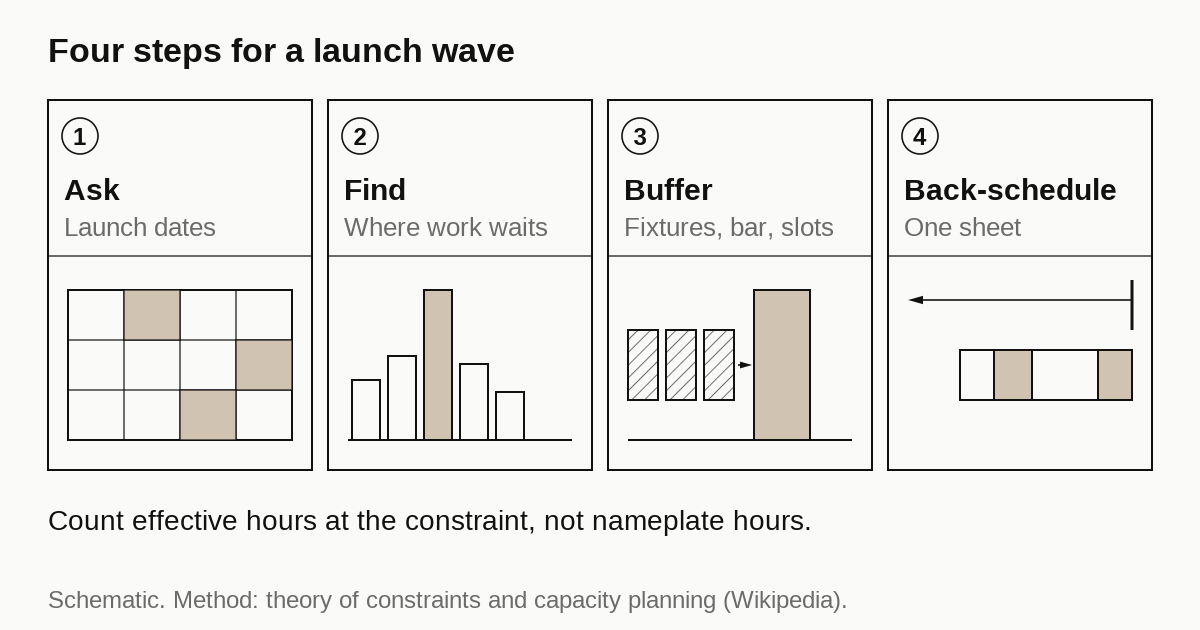
Ask each brand for its calendar
Put these questions to every brand you supply, once a year and again when a launch is approved.
| Question | Why you need it |
|---|---|
| Which model-year or launch date does this part belong to? | Sets the date the parts must be in the brand’s warehouse |
| When are the dealer commitments or catalog dates? | Tells you when volumes get firm |
| Which fairs or launch events does the brand plan for? | Explains why samples are needed early |
| Is there a forecast, and which releases are firm? | Separates what to prepare from what to build |
| When will color and finish be approved? | Finishing is the step that waits for a decision |
| Which lab slots does the brand have for fatigue tests? | A failed test sends new parts back through your queue |
| What changes at the new model year: part, finish or both? | A finish-only change touches different capacity than a part change |
Write the answers in one sheet per brand and keep it with the drawing. Our weekly production update template is a good way to keep those dates in front of the brand once a wave is running.
Find the constraint before you add anything
Wikipedia’s entry on the theory of constraints defines a constraint as the limiting factor that prevents an organization from getting more throughput, and notes that a system has at least one and only a few. Its five focusing steps start with identifying the constraint, then deciding how to exploit it and subordinating everything else to that decision. Adding machines that do not touch the constraint does not raise what you can ship.
In a bike part shop the candidates are specific.
| Candidate | How it shows up | A buffer that fits |
|---|---|---|
| One machine group, such as the 5-axis or the lathes | Jobs wait in front of it while others sit idle | Move work that can run elsewhere, group families on it, keep it running through breaks |
| A fixture that exists once | Two customers need the same fixture in one week | Build the second fixture before the wave. See fixturing for repeat runs |
| First article inspection | Finished first pieces wait for a measuring slot | Book the inspection time in the plan. See first article inspection |
| The anodizing batch cycle | Parts wait until enough pieces fill a load | Book finishing slots with the anodizer, agree batch sizes and color approval early. See color matching across batches |
| Bar and billet supply | Material arrives after the program is ready | Buy bar on the forecast, with the brand’s written approval. See supplying billet to bike part machinists |
The same Wikipedia entry describes drum-buffer-rope: the constraint sets the pace, a time buffer protects it from starving, and work is released to the floor one buffer before it is due at the constraint. For a shop, the practical version is to release material and programs early enough that the constraint never waits for them, and to stop releasing work faster than the constraint can take it.
Need a quote for this part? Get a quote for your bike parts
Count effective capacity, not nameplate hours
Wikipedia’s capacity planning entry separates design capacity, the most work that can be done in a period, from effective capacity, which is lower because of delays and quality problems. The same entry points to overall equipment effectiveness as a way to use existing capacity better. That measure is availability times performance times quality, and its own Wikipedia entry warns that assuming one fixed benchmark percentage is, in many cases, wrong. Take your own figure from your own records.
The same entry lists three strategies for timing capacity against demand: a lead strategy adds capacity before demand rises, a lag strategy adds it after the shop is full and a match strategy adds it in small steps. A launch wave lasts weeks, not years, so buying machines for it is a lead strategy with a long payback and a lot of risk. Most shops do better by buffering the constraint than by adding spindles.
An illustration with made-up round numbers, not market data. A shop has two machining centers and plans 80 spindle hours each per week, which is 160 design hours. Its records show 70 percent of that is effective after setups, downtime and rework, so 112 hours. Three brands release work in the same six weeks and the total needs 140 hours a week at those machines. The gap is 28 hours a week, or 168 hours over the wave. The options are to pull work forward in the quiet weeks before it, move some operations to the second shift, agree a staggered release with one brand or decline part of the wave. Each is a choice you can make early, and none is available the week the PO arrives.
Back-schedule from the ship date
Our guide to lead time on machined bike parts lists the stages of an order from release to delivery. Use the same stages in reverse: start from the date parts must reach the brand’s warehouse, then subtract transport, final inspection and packing, finishing, first article approval, machining, the queue, programming and material.
| Stage, counted back from the ship date | Your days | Who confirms |
|---|---|---|
| Transport and customs | Forwarder | |
| Final inspection and packing | You | |
| Finishing, including waiting for a batch | Anodizer | |
| First article approved | Brand | |
| Machining and deburring | You | |
| Queue at the constraint | You, from the load sheet | |
| Programming and fixturing | You | |
| Material in the building | Supplier |
We found no public figure for the days in any of these stages on bike parts, so the column is blank. Fill it from your own jobs. Then add the load for every brand to the same sheet and look for the weeks where the constraint is above its effective hours.
What to tell the brand
A forecast is a plan, not a promise. Say in writing what you will do with it: buy bar, book finishing, build a fixture. Say what you need from the brand to release those steps, such as an approved color or a written approval to buy material. Do not promise capacity you have not found. A brand that hears an early “no” on a date can still plan, and a brand that hears a late “no” cannot.
If a launch date slips on the brand’s side, ask for the new date in writing and rework the sheet. If a release arrives earlier than the forecast, show which other brand’s work moves as a result.
Talk to us
If your shop mills aluminum bike parts and wants to be considered for work for brands abroad, read the for suppliers page and talk to us. We will tell you plainly whether your parts and finishing route fit the requests we see.
Sources
- Bicycle Retailer, Dealers play the dating game with early ordering (September 2011)
- Bicycle Retailer, Cannondale aligns model-year calendar (July 2020)
- Dirt, Bike companies and the new-range-every-year question (April 2013)
- Wikipedia, Eurobike
- Wikipedia, Theory of constraints
- Wikipedia, Capacity planning
- Wikipedia, Overall equipment effectiveness
- Wikimedia Commons, Tern Booth Container Eurobike 2011.jpg

Frequently asked questions
Why do bike brands order machined parts in waves?
Orders follow the brand's launch calendar: a new model year, a trade show, a dealer pre-season order window. Parts are released ahead of each, so several brands can ask for work in the same weeks. Calendars differ by brand and have changed over time, so ask each customer for its own dates instead of assuming one.
How much capacity should a shop hold back for a launch wave?
There is no standard figure. Work it out from your own numbers: effective hours per week at your constraint, against the hours the expected releases need. Capacity is not the machines on the floor. Wikipedia's capacity planning entry separates design capacity from the lower effective capacity left after delays and quality losses.
What is usually the constraint in a bike part shop?
It depends on the shop. Common candidates are one machine group, a fixture that exists once, first article inspection or the anodizing batch cycle. Find yours by watching where work waits, not by guessing. In the theory of constraints, the constraint sets how much the whole system can ship.
Should a shop ask a bike brand for a forecast?
Yes, and ask for it with a date and a part list. A forecast is not an order, so say in writing what you will do with it, such as buying bar early or booking finishing slots, and what you need from the brand's side to release those. Keep the forecast and the released orders on separate lines.
Need a quote for this part?
Send the drawing. We quote the finished parts, place the work with a partner shop that machines bike parts and reply within 24 business hours.
Get a quote for your bike parts